

The Best SEO and GEO Tools to Run Together combine traditional SEO suites or Google Search Console with GEO platforms that track AI citations and mentions. For example, Otterly.AI Lite is listed at $29 monthly, while larger teams may pair a dedicated SEO suite with a GEO platform to measure rankings, traffic, citations, and competitive visibility.
- SEO aims to drive qualified website traffic through search rankings, while GEO aims to have content selected as a source for AI answers.
- Google Search Console provides data directly from Google for search performance, indexing status, and website health.
- Otterly.AI Lite costs $29 per month and includes prompts, 1,000 GEO URL audits, tracking in more than markets, and unlimited team members.
- AI visibility movement may take six to twelve weeks to become readable, with longer periods in crowded categories.
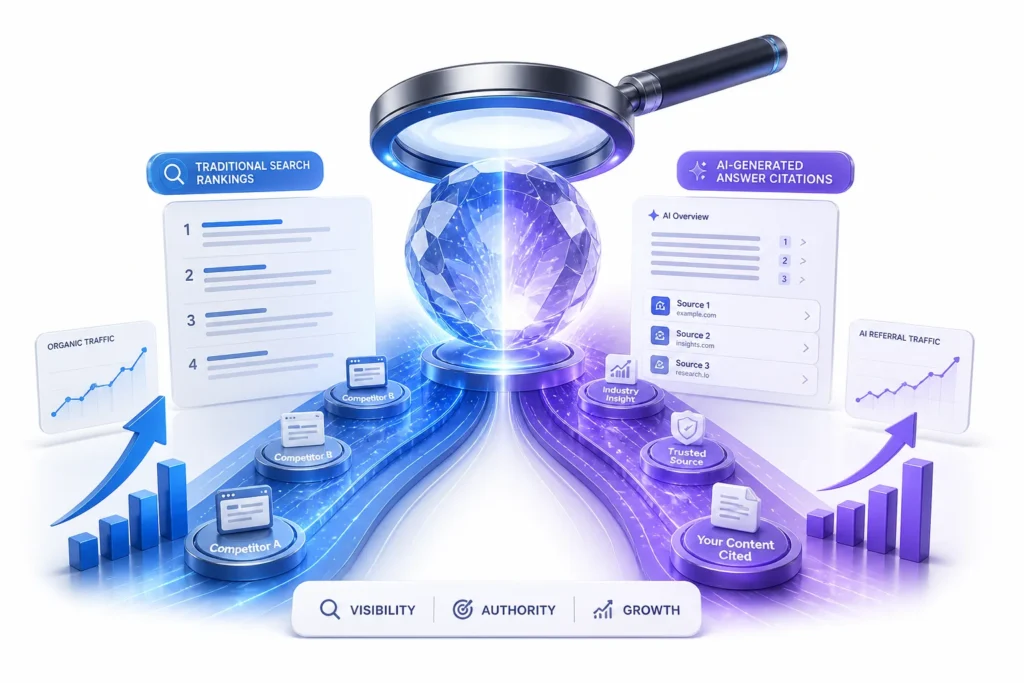
What do SEO and GEO tools each measure, and how do their goals differ?
SEO improves a website’s position in traditional search, while GEO improves the chance that content will be cited in AI-generated responses. SEO targets qualified website traffic through rankings; GEO targets selection as a source for AI answers. The Best SEO and GEO Tools to Run Together therefore measure different outcomes. The Best SEO and GEO Tools to Run Together should connect rankings with citations rather than treat them as identical. The Best SEO and GEO Tools to Run Together can support one measurement plan when you define both outcomes first.
AI visibility trackers measure how often AI engines mention a brand, while content platforms help create and structure pages those models read. That distinction matters: one category observes visibility, and the other helps shape the material being evaluated.
AEO and GEO are described as extensions of a strong SEO foundation rather than separate strategies from SEO. The ledger also reports that Google rewards rankings while AI engines quote the source that answers a question best, regardless of page rank.

Which are the Best SEO and GEO Tools to Run Together for rankings, traffic, citations, and mentions?
The Best SEO and GEO Tools to Run Together pair traditional search data with AI-answer visibility data. The Best SEO and GEO Tools to Run Together can cover rankings, organic sessions, citations, and brand mentions without assuming that one product measures every category. The Best SEO and GEO Tools to Run Together should be selected around the questions your team needs to answer.
Traditional SEO tracking can include keyword positions, ranking distribution, SERP features, competitor positions, organic sessions, traffic growth, landing-page performance, and search queries. GEO tracking can include citation frequency and prominence, competitive citation ratio, answer inclusion, citation traffic, and citation conversions.
| Category | What the ledger supports | Example |
|---|---|---|
| SEO suite | Rankings, competitors, technical crawling, and backlinks | Dedicated SEO suite for larger teams |
| GEO platform | Citation and AI-visibility reporting | AI Rank Lab or Authoritas |
| Google data source | Search performance, indexing, and website health | Google Search Console |
Larger teams usually pair a dedicated SEO suite with a GEO platform. AI Rank Lab reports citation-rate trends, competitor benchmarks, and prioritized recommendations, while Authoritas offers regional targeting and multi-client citation monitoring.
What features and integrations should you compare when choosing a combined SEO and GEO tool stack?
The Best SEO and GEO Tools to Run Together should be compared by limits and measurement definitions, not by product labels alone. The Best SEO and GEO Tools to Run Together may produce different results when they sample different engines or markets. The Best SEO and GEO Tools to Run Together also need a clear handoff between search data, AI monitoring, content work, and reporting.
Compare limits for prompts, engines, sites, seats, refresh frequency, and content volume. Coverage can differ by the AI engines and countries sampled, query frequency, and whether a product counts mentions or linked citations. Those differences can make two reported visibility rates non-equivalent.
- Check traditional SEO data, including rankings, search queries, organic sessions, and landing-page performance.
- Check AI-engine coverage, country support, refresh frequency, and the product’s citation definition.
- Check reporting, seats, sites, prompt allowances, and content volume.
- Check regional support and whether the workflow connects to content production; specific integrations are unknown where the ledger does not list them.
AI Rank Lab’s agency dashboard gives each client a separate keyword set, competitor list, and reporting schedule, with typical client sets containing 15–50 queries.

How much do popular SEO and GEO tools cost, and which capabilities are included in each pricing tier?
The Best SEO and GEO Tools to Run Together span listed prices from $29 per month for Otterly.AI to $199 monthly for Semrush SEO + AI Search. The Best SEO and GEO Tools to Run Together should be compared by included prompts, engines, domains, articles, and reporting scope. The Best SEO and GEO Tools to Run Together may have materially different limits even when monthly prices look similar.
| Tool | Listed price | Included scope stated in the ledger |
|---|---|---|
| Otterly.AI Lite | $29 monthly; $25 billed annually | 15 prompts, 1,000 GEO URL audits, more than markets, unlimited team members |
| Scalenut Starter | $59 monthly | Weekly tracking for prompts across ChatGPT and Google AI Overviews; one workspace, one domain, five articles, five page optimisations |
| Semrush SEO + AI Search | $165.17 annually; $199 monthly | Starter covers daily prompts on one domain |
| HubSpot AEO | $50 monthly | Continuous prompt monitoring; no HubSpot subscription required |
| Profound | From $99 monthly; enterprise from $500 or more | ChatGPT tracking only at the listed starting price |
| Ahrefs Brand Radar | From $199 monthly | Sold standalone; paid Ahrefs plans include a small daily AI prompt allowance |
| AI Rank Lab | From $149 monthly | Agency price doesn’t rise as clients are added |
| Authoritas | From $99 monthly | Regional targeting and multi-client citation monitoring |
Otterly.AI lists four base engines, with Claude, Gemini, and Google AI Mode as paid add-ons. Trakkr Growth includes one brand, prompts, and articles; multi-brand support is available only at Scale.

How can you combine SEO and GEO tools into a workflow for keyword research, content optimization, and performance tracking?
The Best SEO and GEO Tools to Run Together work best in phases: assess first, build the technical foundation, then improve content and monitor results. The Best SEO and GEO Tools to Run Together should use the same customer questions and confirmed facts across search and AI work. The Best SEO and GEO Tools to Run Together become more useful when you document each change beside its later visibility data.
- Spend 1–2 months on audits, competitor analysis, opportunity identification, and metric planning.
- Spend 2–3 months addressing technical SEO issues, implementing schema markup, and improving site architecture and internal linking.
- Spend 3–6 months improving existing content, filling gaps, optimizing entities, and adding structured elements and expert contributions.
- Ask ChatGPT, Gemini, and Perplexity the same customer question without naming the brand to establish a baseline.
- Find questions where competitors are recommended, then generate and score GEO content from confirmed facts. Update older content with current keyword research while keeping it accurate and valuable.
A reported 10,000-query benchmark found that expert quotes boosted AI visibility by 41%; that result is attributed to the source’s report, not presented as a guarantee. AEO retainer work can include quotable content, entity and schema work, citation building, community presence, and visibility monitoring.
Document schema updates, published content, and technical fixes alongside related citation-rate changes.
What data gaps or trade-offs should you expect when using SEO and GEO tools together?
The Best SEO and GEO Tools to Run Together don’t share one standardized AI-visibility measurement system. The Best SEO and GEO Tools to Run Together can disagree because vendors sample different models and countries, run queries at different frequencies, and count mentions or linked citations differently. The Best SEO and GEO Tools to Run Together therefore require definition checks before you compare their numbers.
Third-party SEO metrics, scores, and forecasts are estimates rather than official Google data because those platforms don’t access Google’s internal ranking systems. No Search Console equivalent exists for AI visibility, and vendors measure citations differently.
The cited Pew Research Center measurement reported traditional-result clicks on 8% of searches when an AI summary appeared, compared with 15% when no summary appeared. Another report says AI Overview citations from organic top-10 pages fell from about 76% in mid-2024 to roughly 38% in 2026.
Analysis of roughly 548,000 retrieved pages found that ChatGPT cited about 15% of the pages it retrieved while researching an answer. SE Ranking’s AI Overview add-on starts at $65 per month but doesn’t track citations from ChatGPT, Perplexity, or Claude.

How can you measure whether a combined SEO and GEO tool stack improves organic traffic and visibility in AI-generated answers?
The Best SEO and GEO Tools to Run Together should be judged against a baseline for organic traffic, rankings, search queries, citation rates, and AI-engine mentions. The Best SEO and GEO Tools to Run Together need repeated measurements rather than a single AI answer. The Best SEO and GEO Tools to Run Together can support a GEO Blueprint measurement model for businesses, agencies, SaaS companies, and online brands across ChatGPT, Gemini, Perplexity, and Google AI Overviews.
- Record organic traffic, rankings, search queries, citation rates, and AI-engine mentions before changes.
- Report citation rates for ChatGPT, Gemini, Perplexity, and Claude as percentages with a trend line from baseline.
- Compare those rates with three to five identified competitors.
- Run at least two or three measurement cycles before treating week-to-week AI-answer changes as meaningful.
- Expect six to twelve weeks before AI-visibility movement is readable, and longer in crowded categories.
- Separate the suggested three-to-six months for citations to appear in tracking from the six-to-12 months suggested for judging return.
Document schema updates, published content, and technical fixes beside related citation-rate changes. The ledger provides no performance guarantee; use the GEO Blueprint model to report observed changes across the named engines and compare them with the work completed.

| Tool | Listed price | Pricing or scope details |
|---|---|---|
| Otterly.AI | $29 per month monthly or $25 per month billed annually | four engines at base and Claude, Gemini, and Google AI Mode as paid add-ons |
| Scalenut Starter | $59 per month | weekly tracking of up to prompts across ChatGPT and Google AI Overviews, one… |
| Semrush SEO + AI Search | $165.17 per month annually or $199 monthly | its Starter tier covers daily prompts on one domain |
| HubSpot AEO | $50 per month | continuous prompt monitoring and does not require a HubSpot subscription |
| Profound | starts at $99 per month | for ChatGPT tracking only |
| Ahrefs Brand Radar | starts at $199 per month | is sold standalone, and paid Ahrefs plans include a small daily AI prompt… |
| AI Rank Lab | starts at $149 per month | its price does not rise as clients are added |
| Authoritas | pricing from $99 per month | offers AI citation monitoring with regional targeting and multi-client account… |
| SE Ranking | listed price starts at $65 per month | AI Overview tracking add-on covers Google AI Overviews but not citations from… |
Key Takeaways
- Define rankings and qualified traffic as SEO outcomes, and citations and AI-source selection as GEO outcomes.
- Compare prompt, engine, market, site, seat, refresh, and content limits before choosing a stack.
- Use Google Search Console for Google-sourced search, indexing, and website-health data, then add GEO tracking for AI visibility.
- Measure baseline and competitor trends over multiple cycles rather than treating one week of AI answers as decisive.
- Document technical fixes, schema updates, and published content beside changes in citation rates.
Frequently Asked Questions
What is the difference between SEO and GEO?
SEO measures traditional search rankings and related website performance, while GEO measures whether content is cited in AI-generated responses. SEO seeks qualified traffic; GEO seeks selection as a source for AI answers.
Which tools track both SEO and AI visibility?
Google Search Console provides Google-sourced data for search performance, indexing status, and website health. GEO platforms add measures such as citation frequency, citation prominence, answer inclusion, and citation conversions.
How much do SEO and GEO tools cost?
Listed prices range from $29 per month for Otterly.AI Lite to $199 monthly for Semrush SEO + AI Search, while other options include Scalenut, HubSpot AEO, Profound, Ahrefs Brand Radar, AI Rank Lab, and Authoritas.
How do you measure whether SEO and GEO work together?
You can measure a combined stack by recording organic traffic, rankings, search queries, citation rates, and AI-engine mentions before changes, then comparing trends across ChatGPT, Gemini, Perplexity, Claude, and competitors.
